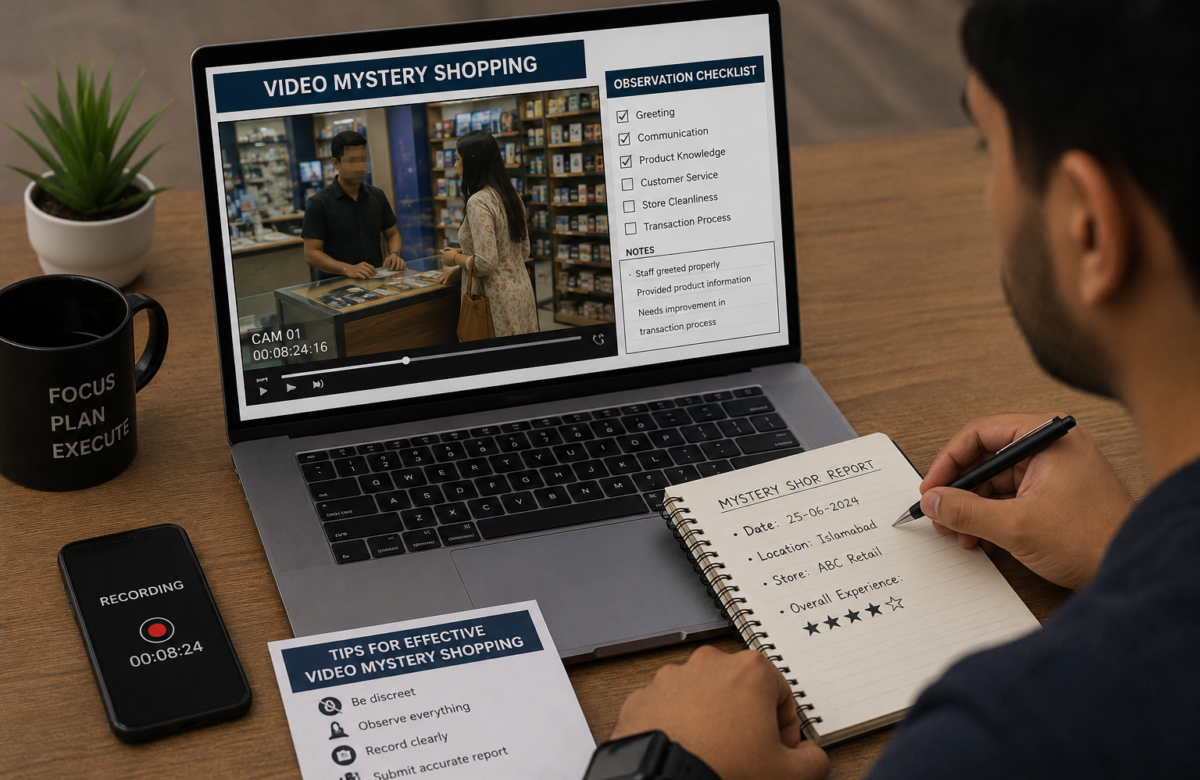

Hidden camera audits improve employee accountability by recording exactly how staff behave when they believe no one is watching. Covert video is different from scheduled inspections or self-reported checklists because it captures authentic behavior in real time, thereby revealing when procedures are being followed and when they are being broken. When there is evidence instead of only assumptions, it becomes much easier to ensure accountability.
This guide will explain the concept of hidden camera audits, why they are more effective than traditional audits, what the data show about the use of such audits, and provide practical hints on how to conduct them.
What Is a Hidden Camera Audit?
A hidden camera audit refers to an undercover method where an individual is able to see how the employee acts in front of the customer without the employee’s knowledge. It uses a hidden camera and a professional (for example, a mystery shopper) who watches the footage. After recording, the expert reviews the footage and prepares a scorecard to evaluate specific parts of the process such as handling customer queries, compliance with guidelines, honesty, and treatment of customers.
The difference between a hidden camera and CCTV is that while CCTV footage is regular and passive, a hidden camera audit is precise and planned; in fact, it presupposes that a shopper will approach a worker with a specific query and see his/her reaction.
Why Accountability Breaks Down Without Direct Evidence
The majority of accountability systems rely on self-reporting, manager spot-checks, and complaints from customers, which all suffer from the same flaw: they depend on someone coming forward to report a problem.
- Self-reporting is unreliable. Employees seldom provide evidence of their own violation of company policy.
- Manager spot-checks are subject to over-managing. Employees tend to change their behavior if they know that a supervisor is conducting the check. This is known as the observer effect.
- Complaints do not happen too often. Numerous surveys in different industries, including the ones mentioned by Greenbook, show that most unhappy customers never submit any complaints, which means that mostly nothing is reported about service failures and rule violations.
It takes a long time for internal fraud to be detected. Data from fraud audits in the relevant industry indicates that the average internal fraudulent scheme takes more than a year to be detected due to the absence of any evidence until somebody notices a problem.
How Hidden Camera Audits Improve Employee Accountability
Effective employee theft prevention surveillance rests on the same six mechanisms that make hidden camera audits work for accountability more broadly:
-
They Remove the “He Said, She Said” Problem
When a customer complaint or manager observation conflicts with an employee’s account of events, there’s rarely a way to settle the disagreement. Video footage ends that ambiguity; the interaction is on record, and accountability conversations shift from arguing over what happened to discussing what to do about it.
-
They Test Real Behavior, Not Rehearsed Behavior
Employees who know an inspection is coming can temporarily tighten up their conduct. A hidden camera audit, by design, captures how staff acts on an ordinary day, with an ordinary customer, under no special scrutiny, which is a far more accurate accountability baseline than a scheduled walkthrough.
-
They Create a Deterrent Effect
Once workers realize that any customer interaction can be checked after the fact, their behavior changes for the better, since knowing that the data can be assessed makes them behave appropriately, not only during the times they know they’re being watched. This coincides with the findings of research studies in loss prevention wherein continuous monitoring impacts the behavior of personnel even when the interactions that are not monitored actually take place, as staff cannot tell when and which of their actions will be recorded.
-
They Detect Issues Traditional Audits Miss
Written checklists are good at catching what they’re designed to look for, but they can’t catch what wasn’t anticipated. Video captures the full interaction, so it often reveals problems no one thought to check for: a script being skipped in a specific way, an unauthorized side-deal offered to a customer, or a discount policy being applied inconsistently.
-
They Turn Accountability Into Coaching
A policy infraction reported in writing serves as a data point. A video of the violation, however, serves as a teaching opportunity; a manager can now show the employee where the procedure went wrong and what the right procedure looks like, making it a much more effective way to influence performance than a written report alone.
-
They Support Fair, Evidence-Based Discipline
Disciplinary action that is based on reports that are not directly taken from the person having the experience is subject to more objections and may sometimes result in a legal dispute. When video evidence is available, the management and HR department have a basis for action that can be regarded as correct and verified.
What the Data Shows About Accountability and Surveillance
The case for hidden camera audits isn’t just theoretical; loss-prevention and fraud research consistently point to a real, measurable accountability gap:
- Occupational fraud research from the Association of Certified Fraud Examiners attributes roughly a third of reported fraud cases directly to employee theft, with a median case costing well over $100,000 before detection.
- Industry analysis compiled by Embroker notes that close to a third of internal fraud cases happen specifically because a business lacked adequate internal controls, monitoring being one of the most cited gaps.
- Multiple loss-prevention studies estimate that structured employee monitoring, including audits and surveillance, can meaningfully cut theft incidents, particularly when paired with clear, consistently enforced policies.
- The National Retail Federation’s security survey data shows internal theft accounting for close to a third of total retail shrinkage, a scale large enough that even a modest reduction in undetected incidents represents significant savings.
None of these figures are specific to hidden camera audits alone; they reflect the broader accountability gap that direct observation, including video, is built to close.
Legal and Ethical Considerations
The use of hidden cameras for audits has legal complications, which can differ from one region to another. The generally accepted best practices for conducting hidden camera audits are threefold: recordings must be made only of employees working on the employer’s premises, the recordings must be kept confidential and accessible only to authorized parties, and there should be a workplace monitoring policy that covers the employees without them being informed about the impending audit. For a deeper look at how this applies specifically in Pakistan, see our companion guide on the legality of video mystery shopping.
Best Practices for Running a Hidden Camera Audit Program
- Clearly state your purpose. Different scenarios need to be planned based on theft prevention, service quality, and compliance monitoring objectives.
- Keep footage confidential. Allow management and HR to access only the necessary information without granting permission to others.
- Use effective monitoring policies. Employees should know that they can be monitored.
- Use findings for training, not punishment. Programs combining accountability and education have proven to yield better results than programs that focus on discipline alone.
- Use in conjunction with other methods. Written audits and customer surveys will still help considerably despite the high effectiveness of video monitoring in crucial situations.
Limitations to Keep in Mind
While hidden camera audits do serve the purpose of accountability, they cannot be solely relied upon. They are usually more expensive at a larger scale than checklists, require the footage to be handled with care to avoid any legal issues that come with it, and also capture only the specific interactions being audited and not the whole picture that a regular inspection would provide. Most effective accountability programs treat video as one layer within a larger system of policies, training, and routine audits, which we cover in more detail in our guide to mystery shopping services.
Conclusion
The efficacy of accountability depends on evidence, not assumptions. While self-reported data, complaints, and spot-checking can provide some information, these measures rely heavily on someone noticing and then reporting the issue, and often, this doesn’t happen. In this regard, the hidden camera audit fills the gap and shows exactly what happened, how and when it happened.
When hidden camera audits are used effectively, within strict bounds, with employees monitored at work, their privacy kept intact, and with the help of monitoring policies, these audits can give companies something written reports cannot provide: the actual documentation of how employees work in real life.
FAQs
How can the employment of hidden camera audits help in improving employee accountability?
Their use allows companies to obtain actual proof instead of making assumptions. Management will no longer depend on self-reports or occasional complaints and will be able to see how exactly an employee reacts in a real situation. This means that issues can be solved more accurately, specific actions can be coached, and disciplinary measures can be applied correctly if needed.
Can hidden camera audits be treated as more efficient than manager spot-checks?
In many cases, yes. Because employees tend to behave differently when a supervisor observes them, a situation known as the observer effect, hidden camera audits capture how people behave when uninfluenced or not supervised, allowing management to get an adequate picture of how accountable employees are in everyday life.
Can hidden camera audits influence the number of thefts committed by employees?
According to the research, structured monitoring helps to decrease the number of theft incidents, especially in cases where there is a clearly defined policy and consistent application. The possibility of a hidden camera audit becomes a good deterrent for employees, and dishonest behavior is reduced.
Is the use of hidden cameras to carry out employee audits allowed under the law?
This completely depends on the local jurisdiction, although most organizations rely on strict procedures consisting of recordings available only when the activity of employees takes place at the employer’s premises, all video material being confidential, and an overall monitoring policy being applied. Laws on this issue differ from country to country, which means that companies have to make sure that they comply with local requirements before starting to use that kind of approach.
Can the video obtained from hidden cameras be used for educational purposes rather than punishment?
Yes, many companies find that this approach is very effective. The video evidence demonstrates everything that has happened, making it a very practical educational tool, unlike the points given in a checklist, where employees get an idea of what they did wrong but not always how to carry out the procedure correctly.