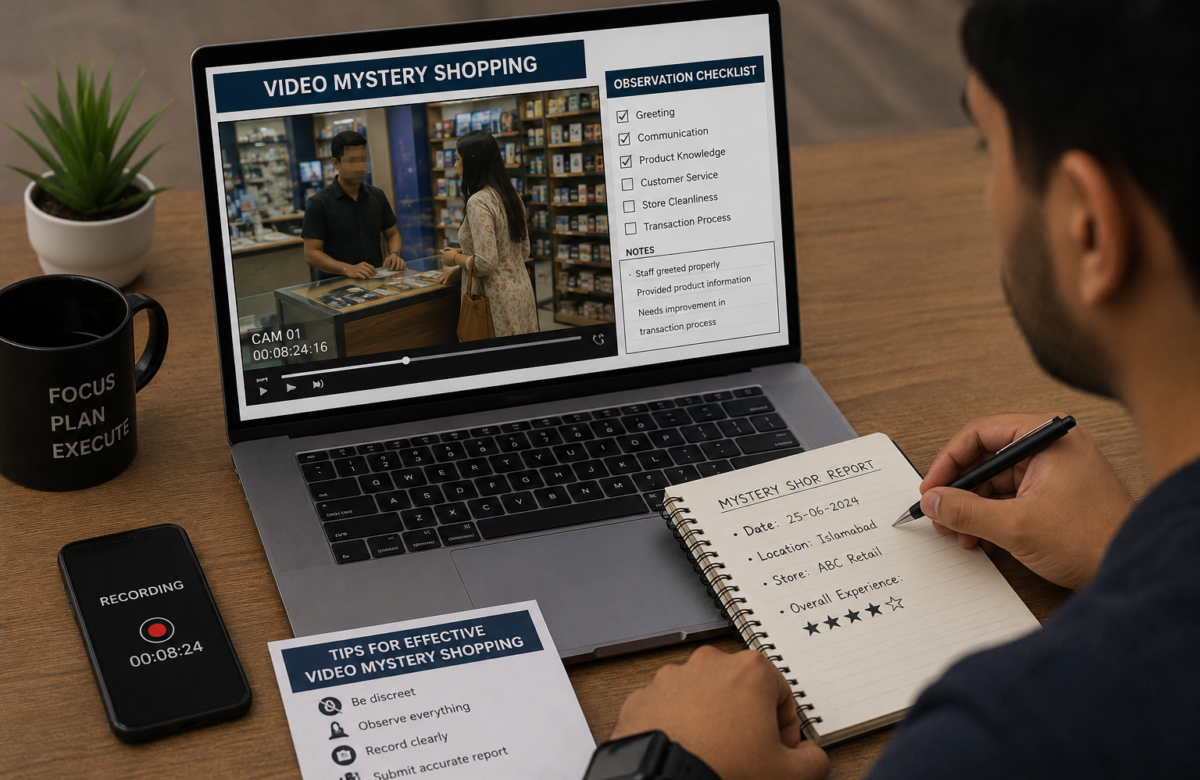

Every bank branch manager, retail area supervisor, and dealership owner in Pakistan has asked some version of the same question: what actually happens when my staff thinks no one important is watching? Video mystery shopping was built to answer exactly that, and it has quietly become one of the most requested customer-experience services among banks, telecom franchises, restaurants, and retail chains across Karachi, Lahore, and Islamabad over the last few years.
However, as soon as a covert camera makes its way into a business, the second question arises: is any of this legal? Video mystery shopping is not expressly prohibited under Pakistani law. Its legality depends on how it is conducted, how the footage is used, and whether it complies with applicable laws such as PECA 2016 and other relevant legal principles.
In fact, it is a valid question, and an accurate answer is necessary. This guide explains the laws regarding video recording of people without their knowledge in Pakistan, and where video mystery shopping in Pakistan fits within that legal picture.
What Is Video Mystery Shopping?
Video mystery shopping is a method to evaluate the customer experience. A trained “shopper” (pre-trained on a scenario, such as opening a bank account, test-driving a car, or complaining about a late food delivery) visits a business in an ordinary customer’s role. They record the whole situation using a hidden camera or a recording device as they observe the complete interaction, such as waiting to be greeted, explanation of products, staff procedures, complaints, and the way that was handled.
The footage is then assessed using a scorecard which rates various aspects such as greeting and courtesy, product knowledge, sales technique, and SOP compliance. Video introduces an evidentiary element beyond a written mystery shopping report. This report is based on the shopper’s memory and notes; video puts management in a position to watch the actual moment a customer was ignored or a script was skipped, for example, instead of taking a shopper’s word for it.
Video Mystery Shopping vs. Traditional Mystery Shopping
Most agencies offering this service in Pakistan and internationally pitch video and traditional (written-report) mystery shopping as complementary rather than competing tools.
Traditional mystery shopping uses a series of questions, a story from the shopper, and possibly photographs and receipts to back up the story. It is less expensive per visit, faster to roll it out across dozens or hundreds of visits, and is appropriate for regular visits.
Video mystery shopping trades some of that scalability for depth. It’s better suited to complex, high-value interactions, such as a mortgage consultation, a car purchase, or a hospital admission, where body language, tone, and the precise sequence of what was said actually matter for coaching and dispute resolution. It’s also considerably more expensive and logistically harder to run at scale, since footage needs review, editing, and quality control before it’s usable.
Frequently, many organizations find themselves using a hybrid approach: video in major branches or high-risk locations, written reports in their broader network.
Is video mystery shopping in Pakistan Legal?
This is where a lot of local providers get vague, and understandably so, because the honest answer is: it depends on how it’s done, and Pakistan’s legal framework here is thinner than most people assume. You should know whether video mystery shopping is legal in Pakistan.
-
No Dedicated Data Protection Law
Since around 2005, Pakistan has had discussions on a Personal Data Protection Bill, with several versions since then, the most recent of which is from 2023 and recommends the establishment of a National Commission for Personal Data Protection. Up to now, none of these drafts have been enacted. This means Pakistan currently lacks a unified comprehensive law that regulates the process where a company collects, holds, or uses footage of its customers or employees, like the European GDPR law.
-
PECA 2016 is an Important Law
In the absence of a dedicated privacy law, the Prevention of Electronic Crimes Act (PECA) 2016 does most of the heavy lifting, and it is not toothless.
- Section 24 primarily concerns recording private activities. Whether it applies depends on the circumstances and the reasonable expectation of privacy.
- The Pakistan Penal Code’s Section 354-C separately criminalizes voyeurism, watching or recording a person’s private acts without consent.
- Under Section 38 of PECA, transferring someone’s personal or sensitive data without their consent, except where legally required, can result in up to three years’ imprisonment, a fine of up to PKR 1 million, or both.
- Sections 3 and 4 make unauthorized access to, or copying/transmission of, someone’s data a punishable offense in its own right.
-
Article 14 of the Constitution adds a Layer, with Limits
According to Article 14, “human dignity” as well as the security of households is to be safeguarded. The legal system in Pakistan has interpreted this provision while passing judgments related to cases of unapproved data gathering from personal information-bearing devices, conceiving it as part of the general scheme of protection for confidentiality as guaranteed by the Constitution. But the official application of Article 14 makes it possible for Parliament to restrict the use of this provision. It means that the constitutional rights affect the state more than private companies, thus limiting the chances of appealing to Article 14 by customers against the actions taken by mystery shopping entities.
Why Video Mystery Shopping Generally Survives this Framework
Given all of the above, why do banks, telecom operators, and retail chains still commission video mystery shopping in Pakistan without apparent legal trouble? A few reasons line up with how the law is actually applied:
-
Premises belong to the Client Commissioning the Audit
Usually, the subjects who are being recorded in typical assignments are the employees of the client, and they are located where the client works, fulfilling a function involving clients. This scenario is more akin to the usage of workplace cameras for security purposes by Indian employers than to clandestine monitoring of any person. In particular, it is generally accepted that employers can control employees’ actions within commercial environments for legitimate purposes.
-
The Footage isn’t Distributed Publicly
PECA’s most lethal power focuses on transmission and distribution. This includes showing the footage, using it in posts, or using it to intimidate or humiliate someone. In the case of a properly managed mystery shopping project, footage stays protected in a confidential client dashboard, open only to authorized managers, thereby immensely minimizing any legal risk involved with the recording per se.
Where the Real Risk Sits
The risk in video mystery shopping in Pakistan isn’t really the recording; it’s what happens after.
-
Filming other Customers
Should a mystery shopper’s video unknowingly record another customer, capturing the person’s face and conversation without the knowledge of that individual, the situation may violate what Section 24 of PECA and Section 354-C of the Penal Code were designed to outlaw. Responsible companies help prevent this issue by instructing mystery shoppers to pay strict attention to the employees while minimizing other potential recording subjects.
-
No Internal Policy or Consent Framework
If employees have never been made aware through an HR policy or employment contract that their interactions with customers can be recorded and reviewed in terms of quality, then it is much easier to present a legal case in the future. This is the reason why most reputable service providers, including companies operating in Pakistan, require a decision to be taken regarding the employee monitoring policy before the project starts.
-
Weak Data Handling
Because Pakistan has yet to enact a mandatory breach-notification law, there is virtually no regulatory obligation on agencies to secure footage properly; as a result, the onus is on the client and vendor’s secrecy methods, access restrictions, and retention periods to ensure the confidentiality of the data.
Conclusion
Video mystery shopping in Pakistan is legal. Such practice is part of organizational culture and is widely used. There are no laws like the PECA, the Pakistan Penal Code, or other legislations, which ban organizations from checking the behavior of their workers during communication with clients through discreet video recording inside their workplace. However, just because this practice is widespread, it does not mean that it is risk-free.
It is important to note some aspects of the legality of a video mystery shopping program. One of the most important aspects is the need to record people at their workplace while they work. Then it is necessary to keep the recorded materials private and accessible only to authorized people. Finally, the HR policy of the organization must state that monitoring the interactions is allowed.
FAQs
Is video mystery shopping permissible under Pakistani law?
Generally, yes. There is hardly any legal barrier in Pakistan against a legitimate video recording by a trained shopper of a particular interaction with customer service staff at the premises of a business place for internal evaluation of quality. However, legal complications may arise if this legitimate practice is taken out of line, for example when it comes to filming bystanders, sharing recorded videos publicly, or recording employees without a proper office policy in place.
Do any particular laws regulate this exercise in Pakistan, since there is no particular law governing privacy issues?
The Prevention of Electronic Crimes Act (PECA) 2016 serves, to some extent, to address the issue. The law comprises Section 24, which prohibits recording or broadcasting videos of someone’s private actions without consent; the law also includes Section 38, criminalizing transfer of personal information without consent, as well as Sections 3 and 4 covering unauthorized copying or access of data. In addition to that, the Pakistan Penal Code Section 354-C contains provisions treating voyeurism as a criminal offence.
Can the recorded video footage be used to punish or terminate an employee?
In most situations, it can be. If the video recording was taken on a company’s premises while the employee was performing his/her official work, and there is a valid business policy relating to the monitoring. In Pakistan, due to the absence of a separate privacy law or legislation, the employee may find it difficult to defend himself/herself in situations where monitoring guidelines are absent or if the video recording has been obtained through unlawful means.
What would occur if a mystery shopper happens to record someone who isn’t part of the process?
This is one of the high-risk situations. If an individual is recorded without their consent, laws related to privacy will have to take effect (PECA section 24, Penal Code 354-C).
Is it possible to share this recording with a third party, like a parent company in another country?
In principle, this is permissible only if it complies with data processing regulations agreed between the client and the agency. Furthermore, we have to remember that in Pakistan there is no law that requires information disclosure in case of a privacy breach, and there is still no legislation on data protection.