
Video mystery shopping provides stronger evidence for the interactions it records, while written audits remain better for scale and broader operational checks. Neither method is “wrong”; they solve different problems, and most businesses in Pakistan end up needing both.
Video mystery shopping exists to close that gap. Instead of relying on someone’s recollection of an interaction, management gets to watch it. And it is this distinction that is the reason why the accuracy of video mystery shopping is higher than that of traditional written audits.
Thus, which factors are responsible for this gap in accuracy and in which cases can video mystery shopping not yet substitute for a complete audit program?
Video Mystery Shopping vs Traditional Audits
| Video Mystery Shopping | Traditional Written Audits | |
| Evidence type | Actual footage of the interaction | Shopper’s written summary from memory |
| Accuracy of detail | High, exact words, tone, sequence preserved | Moderate, depends on shopper’s recall |
| Cost per visit | Higher | Lower |
| Scale across branches | Harder to run at high volume | Easy to run across large networks |
| Dispute resolution | Strong, footage settles disagreements | Weaker, relies on one person’s account |
| Best for | High-value, complex interactions | Routine, frequent, operational checks |
| Training value | High, staff see exactly what happened | Moderate, score without full context |
| Setup requirements | Secure storage, access controls, HR policy | Minimal |
The Core Problem With Traditional Written Audits
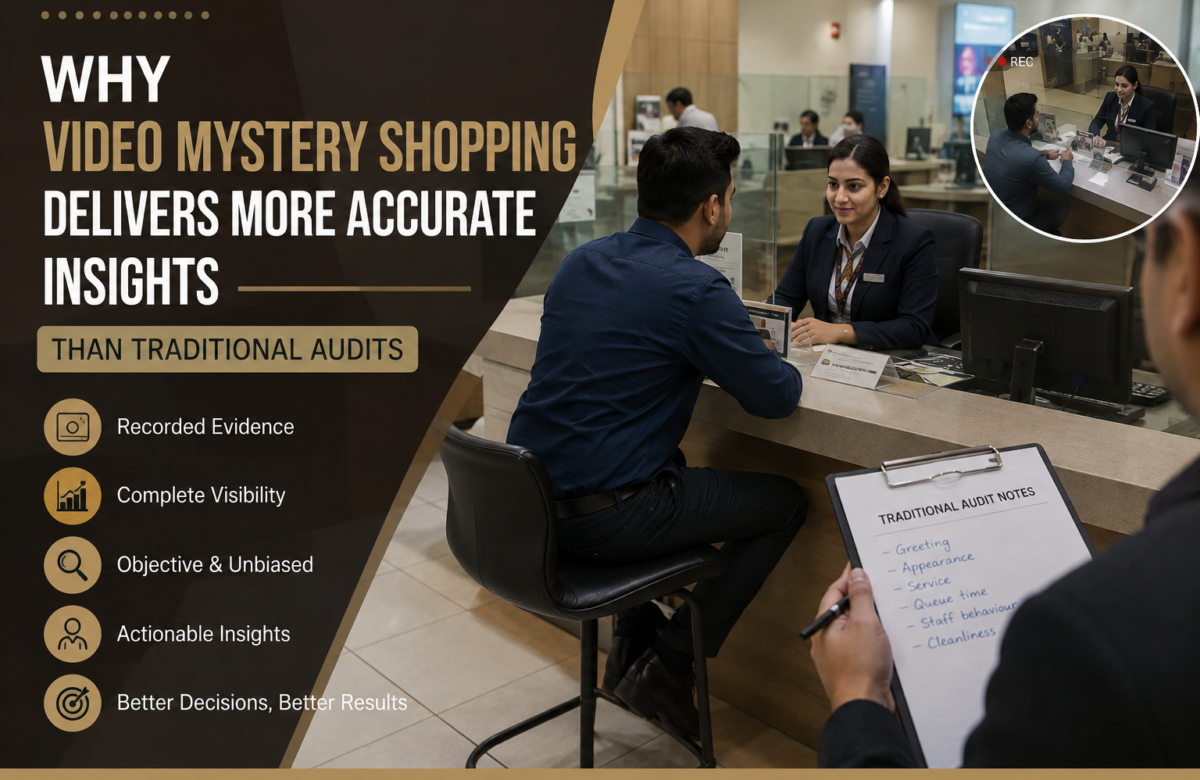
Traditional mystery shopping auditing relies on a level of human perception: an auditor must both observe a situation, remember what occurred, analyze it against the scorecard logically, and then record it after leaving the place. Each point along this line is a potential weak point for accuracy.
- Recall Decay
The memory of a short conversation, even one from an experienced shopper, begins to fade within only an hour. Exact wording, tone, and structure become indistinct, while reports start to reflect only overall impressions and opinions rather than real data.
- Subjective Interpretation
A pair of shoppers watching the same interaction can give different evaluations and metrics for “friendliness” or “product knowledge” because of the impact of personal standards, mood, and expectations.
- Disputed Reports
In cases where reports indicate that a particular staff member was unsatisfactory, the staff member will likely want to dispute this with phrases like “that’s not what happened.” This leaves no real way to check who is telling the truth.
- No Secondary Review
Written reports hardly allow for any additional scrutiny. If the shopper has missed any important detail or misinterpreted something, this information is lost.
Where Video Closes the Accuracy Gap
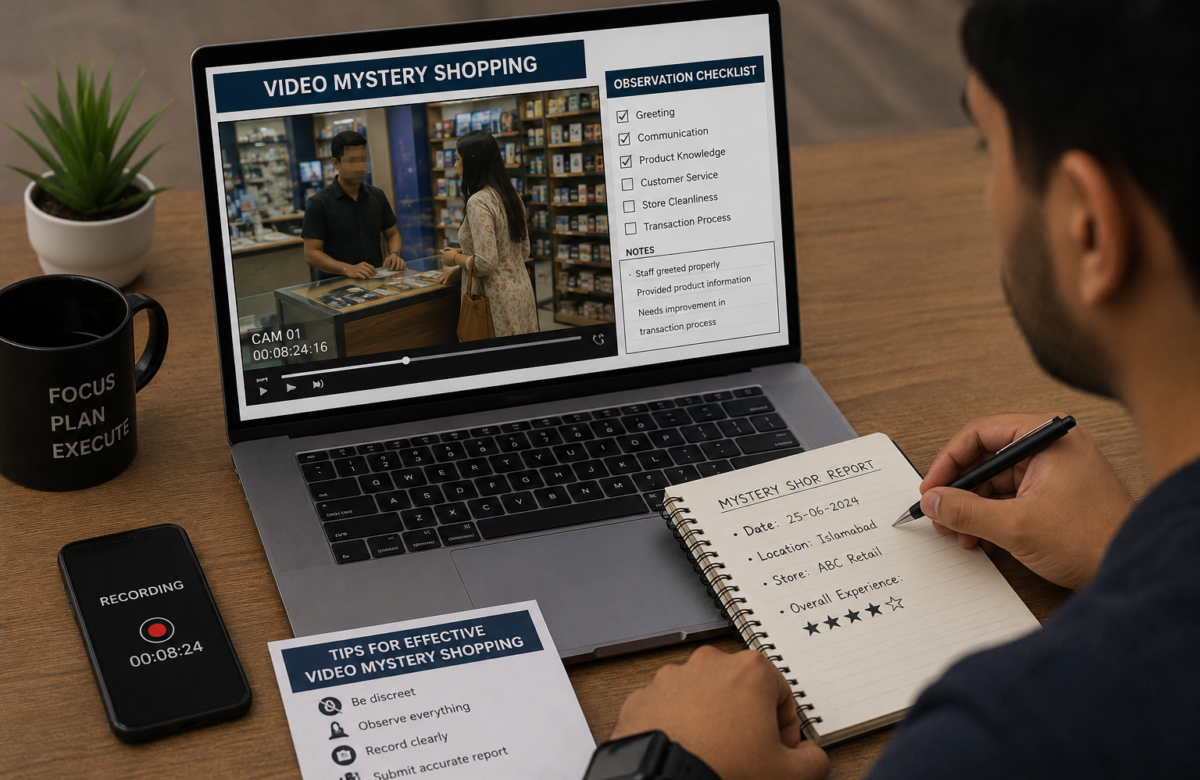
Video mystery shopping alters the nature of the evidence. Instead of a shopper providing a summary of an interaction, management now watches the interaction itself. This change resolves some of the accuracy issues discussed above.
1. No Need to Recall
There is no need to recall any details, as nothing is reliant upon recollection. The video captures the entire interaction. For example, if the greeting was overly curt, if certain details in describing the product were missed, if there was a dismissal of complaints, all of that is recorded verbatim.
2. Replaces Subjective Judgment
A staff member can be called “unhelpful,” but that is just one person’s perspective. When video recording is used, several reviewers, including a branch manager, a region manager, and a human resources manager, can watch the exchange and come up with their own conclusions about it.
3. Ends the “that’s not what happened” Dispute
Due to the recording of the interaction, arguments about what transpired are significantly reduced. The staff can determine precisely what resulted in a low score. It allows the coaching discussions to be more constructive and much less confrontational than fighting over what customers said in writing.
4. Captures Minor Details
Shoppers are instructed to pay attention to certain things, such as the greeting time, the adherence to the script, and the upselling endeavors. Yet, much of what contributes to the experience of the client is something not easy to pick up: body language, hesitation, tone of voice. Written evaluation forms cannot convey that kind of subtlety, but the video can.
5. Genuine Training Asset
Unlike the written report, which gives a staff member a score of 6 out of 10 in terms of product knowledge, the video shows exactly where the interaction went wrong and how it sounded in their own words and voice, and this is a much better coaching aid than just a figure on paper. Many companies engaged in mystery shopping point out this fact as one of the main advantages of this method.
6. Supports more Advanced, Automated Analysis
As video footage banks are created, organizations using video programs can identify trends across multiple visits, recurring issues, seasonal service downtimes, or training needs for particular employees, which is much more difficult to do when looking at reports one by one. In fact, this is how the industry in general is moving, with automated behavior recognition technology already being developed for the purpose of analyzing mystery shopping videos.
How Video Mystery Shopping Improves Evidence Quality
Video changes what the evidence actually is. Instead of a summary, management reviews the interaction directly.
Nothing Depends on Recall
The footage is the record: a curt greeting, a skipped detail, a dismissed complaint are all captured exactly as they happened.
Judgment Becomes Reviewable
Multiple people- a branch manager, regional head, or HR lead- can watch the same footage and reach independent, verifiable conclusions, rather than relying on one shopper’s opinion.
Disputes Largely Disappear
Because the interaction is on record, staff can see exactly what led to a score, which makes coaching conversations more productive and less confrontational.
Subtle Details are Captured
Body language, hesitation, and tone rarely make it into a scorecard, but video preserves them by default.
Coaching Becomes Concrete
A written report might give a 6 out of 10 for product knowledge. Video shows exactly where the explanation went wrong and how it sounded, a far more useful training tool than a number.
This is exactly why most experienced providers, including agencies in Pakistan, don’t position video as a replacement for the full range of mystery shopping services; they position it as the sharper tool for the interactions that matter most.
Most experienced providers use video mystery shopping as a sharper tool to record and monitor the minor details.
When to Use a Hybrid Mystery Shopping Model
Most businesses get the best results by combining both methods rather than choosing one. Traditional written audits cover routine, high-frequency checks across an entire branch network. Video is reserved for high-value or high-risk interactions, such as a mortgage consultation, a vehicle purchase, a claims process, or a formal complaint, where accuracy and detail change the outcome.
This combination gives businesses the coverage of written audits and the evidentiary strength of video, without applying video’s cost to every single visit. For Pakistani banks, telecom operators, dealerships, and healthcare providers, this hybrid model is typically what moves service quality metrics, not an all-or-nothing choice between the two.
Conclusion
Video mystery shopping isn’t about replacing traditional audits; it’s about giving businesses a more reliable form of evidence for the interactions that carry the most weight. Written reports remain the faster, more affordable way to track service consistency across a large network, but they’re still filtered through one person’s memory and judgment. Video mystery shopping removes that filter entirely, which is exactly why it closes the accuracy gap that written audits can’t.
For Pakistani businesses running structured customer-experience programs- banks, telecom operators, dealerships, healthcare providers- the smartest approach isn’t choosing one method over the other. It’s using traditional audits for broad, routine coverage and video mystery shopping for the high-value, high-stakes interactions where getting the details right actually changes outcomes. That combination is what turns a mystery shopping program from a compliance checkbox into a genuine tool for improving service.
FAQs
Is it true that video mystery shopping is more precise than written mystery shopping?
Definitely, when it comes to the exact interaction it records. Video is free of the memory and interpretation errors present in a report prepared by a shopper based on the memory of that interaction since it allows viewers to see the actual exchange instead of relying on the summary. Traditional audits are still better for covering a wide area with high frequency, which is why mystery shopping accuracy in Pakistan is usually strongest when both methods are combined.
What is the reason for written mystery shopping reports being questioned by the staff?
That could happen because such reports rely on the memory of one person and their understanding of what took place. For that reason, staff may contest the result if they present different opinions on the same situation. Unlike written accounts, video eliminates this problem substantially because the actual situation is being viewed instead of someone’s account of it.
Should smaller businesses consider investing in video mystery shopping despite the added expense?
It is contingent upon the source being analyzed. For establishments with limited yet significant customer interactions, such as a car showroom, private hospital, or high-end bank area, the possible advantages of using video footage justify the expense. However, the case is different for mass-market restaurants where regular audits will offer a more affordable assessment.
Do you think a video can help develop employees, not just evaluate them?
Definitely, this is one of the main purposes of this technology. Because the video will show every single detail of the interaction, it will facilitate coaching employees much better than the figures in a report would.